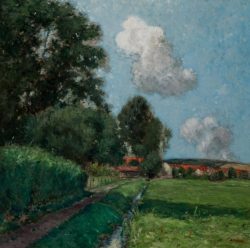
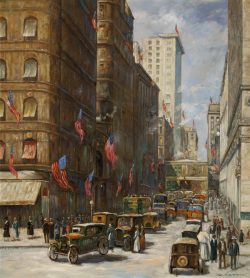
William Clusmann, from an illustration published in Chicago Tribune, May 17, 1908.
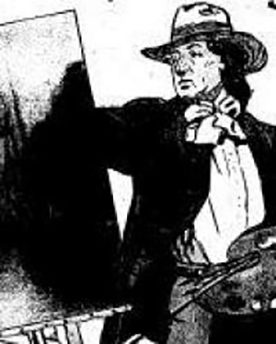
William Clusmann 1859–1927
Born in La Porte, Indiana, William Clusmann moved to Chicago with his family as a boy. After apprenticing to a tinsmith and then in a firm of decorative painters, he studied at the Chicago Academy of Design and its successor, the Chicago Academy of Fine Arts (renamed the Art Institute of Chicago in 1882). To complete his training, he attended the Royal Academy in Munich and the Stuttgart Academy of Fine Arts, returning to Chicago in 1884. Clusmann’s education prepared him to undertake figural paintings and the portraits that were the mainstay of many artistic careers in Chicago; in Europe, he painted portrait heads of German peasant types and scenes of figures in humble interiors. On his return to Chicago in 1894, however, Clusmann established himself as a painter of landscapes, beginning with the first oil and watercolor works he exhibited in the Art Institute’s annual shows. While many of his Chicago contemporaries traveled widely in the U.S. and abroad to paint landscapes, Clusmann remained in his home region throughout his career, with the exception of several years spent in Europe in the 1910s; he made an additional trip to Europe in early 1927.
In the mid-1890s, such prominent Chicago artists as Charles Francis Browne began urging local painters to depict the natural beauty of the surrounding area. By that time, Clusmann was already painting the scenery around the Fox River, west of Chicago. He may have been among the first to exhibit a Chicago street scene when his Wet Day on the Avenue (location unknown) appeared in the Art Institute’s 1896 annual watercolor show; one critic praised it as “a bit of Chicago poetically seen and truthfully portrayed.”i By 1908 the artist had turned his attention to the smoky, congested Chicago River. In this Clusmann followed James Bolivar Needham and Albert Fleury, but his approach differed in the relative monumentality of his canvases; rightly or not, his contemporaries credited Clusmann with discovering the artistic possibilities of the polluted urban waterway. His “weirdly potent marines of local scenes” were widely noted and reproduced in newspapers, and at least five of these paintings were published in a “Chicago River Series” of color picture postcards.ii Clusmann’s river paintings were featured in at least three separate solo exhibitions at the Marshall Field and Company department store between 1908 and 1918 and another at the Newcomb & Macklin gallery in 1923, in addition to being included in the Art Institute’s annual exhibitions of work by Chicago-area artists and of watercolor paintings.
For his images of the smoky river, Clusmann painted in blended, muted tones, using a low-keyed range of colors. By the time he returned in 1917 from several years working in Germany, he had adopted the brighter light and colors and the broken brushwork of impressionism; this shift is apparent in several upbeat views he painted in the late 1910s and 1920s from spots near the Art Institute. These and his sunny park scenes were well-received in Chicago. Clusmann’s work was shown in exhibitions up to the year of his death, which occurred shortly after his final trip abroad.
Wendy Greenhouse, PhD
i “In the Art Studios,” Chicago Tribune, Apr. 19, 1896.
ii H. Effa Webster, “William Clusmann Produces Weirdly Potent Marines of Local Scenes,” Chicago Examiner, May 11, 1910.