Martha Baker (1871–1911)

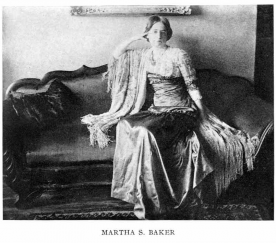
Martha Baker, from a photograph reproduced in A Memorial Exhibition of Works by the Late Martha S. Baker at the Art Institute of Chicago Oct. 1 to 23, 1912 (1912).
Portrait and miniature painter Martha Susan Baker was a native of Evansville, Indiana. In 1898, she completed her studies with honors at the Art Institute of Chicago. She served there as an instructor of sketching and watercolor painting until 1904 and she also taught briefly at the Chicago Academy of Fine Arts (founded in 1902). Baker excelled as a painter of portraits and figural works, but she was best known for her miniature portraits, a genre that enjoyed a vigorous transatlantic revival beginning in the 1890s. The prominent Spanish painter Joaquin Sorolla, who visited Chicago in 1909 and again in 1911, declared Baker the foremost miniature painter of modern times. Baker also painted landscapes in watercolors and in oils, and she was one of several artists who painted murals in the tenth-floor stairwell of the Fine Arts Building, a vital center of cultural life in turn-of-the-century Chicago, where she established a studio in 1899.
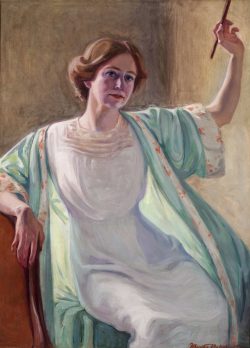
By 1903, Baker was widely recognized as one of Chicago’s most important younger artists. She was among four Chicagoans featured in the 1900 Exposition Universelle in Paris, and she also exhibited in the Paris Salon, at London’s Royal Academy of Arts, and in the United States in numerous national venues. In Chicago, her work was seen in the Art Institute’s annual exhibitions of American art, for work by Chicago artists, and for watercolor painting. She also showed in the annual exhibitions of the Society of Western Artists. Baker’s oil painting In an Old Gown (1904; Union League Club of Chicago) was awarded an honorable mention at the Carnegie International exhibition of 1905 and was purchased by Chicago’s Municipal Art League the following year. The work was characterized by a subdued, almost monochromatic palette. Baker studied pastel drawing during an extended stay in Paris in 1906-09. Thereafter her painting shifted toward what a contemporary deemed a more “modern” manner, characterized by the stronger, purer color, evident in her vivid Self Portrait.[i]
Locally, Baker was widely hailed as one of the Chicago’s most promising artistic talents when she died suddenly, just short of her fortieth birthday. Within a year, the Art Institute mounted an ambitious memorial exhibition of more than fifty of her paintings, pastels, and miniatures, accompanied by an illustrated catalogue. Viewers, according to one reviewer, “cannot help but wonder what would have been the fulfillment had she lived to a period of matured achievement.”[ii]
[i] “The Work of Martha S. Baker,” A Memorial Exhibition of Works of the Late Martha S. Baker at the Art Institute of Chicago, Oct. 1 to 23, 1912 (Chicago: Art
Institute of Chicago, 1912), unpaged.
[ii]Chicago Evening Post, Oct. 5, 1912, in AIC Scrapbooks, v.29.
Martha Baker, Self-Portrait, dated 1911
Oil on canvas, 44 by 32 inches
Completed shortly before her premature death in 1911, Baker’s self-portrait shows the artist apparently in the act of painting. She gazes at the viewer as if at her own image in a mirror and lifts her brush in an expansive gesture that perhaps signals the triumphant completion of her work. Light from behind the figure glows through the diaphanous fabric of her loose-fitting green robe, accentuating her graceful form and highlighting the rich tints of her hair, which writer Carl Van Vechten, the artist’s good friend, called “her great glory.” Missing from this depiction, however, are the spectacles she habitually wore. The portrait is frankly sensuous in its rich coloring and in the long, loose brushstrokes that follow the curves of Baker’s white-gowned body. The face, in contrast, fulfills Van Vechten’s description of Baker’s actual visage as “keen and searching, . . . [wearing] an expression that might be described as wistful; discontent lurked somewhere between her eyes and her mouth.” Writing after her death, Van Vechten believed that Baker was unhappy because her art had never received its due recognition and that she was thwarted artistically because most of her subjects were “silly Chicago ladies.”[i]
With its strong color and preoccupation with light, the portrait exemplifies Baker’s “modern” later style. This departure from the darker, more reserved manner of such earlier works as In an Old Gown (1904; Union League Club of Chicago) was prompted by the artist’s extended stay in Paris between 1906 and 1909, when she embraced pastel, a medium notable for its intense, saturated color and soft textural effects. Baker may have painted this self-portrait for herself, for it apparently was not exhibited in her lifetime and it remained in her family thereafter. When the work was shown in the Art Institute’s memorial exhibition for the artist the year following her death, its relatively loose handling of paint and bright color led one critic to conclude that it was unfinished; the artist’s signature suggests otherwise, however. Although Baker could not have known that this painting was to be one of her last, her contemporaries interpreted it as “prophetic” of the artist’s imminent death: “a worthy feature to crown the work of a gifted life,” it hinted “that art had nobler vistas opening before her.”[ii] The portrait transcends the usual self-image of the professional painter at work, intimating Baker’s aspirations toward a more expressive creativity.
[i] Carl Van Vechten, Peter Whiffle (New York: Alfred A. Knopf, 1922), 26-28.
[ii]Chicago Record Herald, Oct. 6, 1912, and Chicago Evening Post, Oct. 5, 1912, in AIC Scrapbooks, v. 29.