Error message

  • Notice: Undefined index: field_artwork_variant_titles in include() (line 123 of /home/content/77/6792077/html/sites/all/themes/bluemasters/node--artists.tpl.php).
  • Notice: Trying to get property of non-object in include() (line 123 of /home/content/77/6792077/html/sites/all/themes/bluemasters/node--artists.tpl.php).

Lawton Parker (1868–1954)

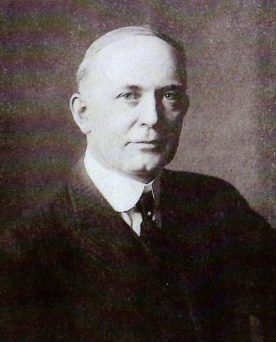
Lawton Parker, from a photograph reproduced in Lena M. McCauley, “Lawton S. Parker,” The Art Student 1 (Oct. 1915).
A farm-boy from Kearney, Nebraska, Lawton Silas Parker began his training at the Art Institute of Chicago as a teenager. In 1888, he went to Paris, where he met the stringent entrance requirements for the prestigious École des Beaux-Arts; he later transferred to the Académie Julian, a favorite among American art students. One of Parker’s paintings was juried into the Paris Salon exhibition of 1890. In the following decade, he led a peripatetic life that included further study at the Art Students League in New York City and in Paris; teachings stints in St. Louis, Chicago, New York, Paris, and Beloit, Wisconsin; and work on commissioned portraits and a mural. He won several scholarships and awards, including honors for his entries in the Paris Salons of 1900 and 1902.

Parker was associated with Chicago between around 1901, when he briefly held a faculty appointment at the Art Institute, and the mid-1910s. In addition to showing his work in the museum’s annual exhibitions of American art, he participated in several of its salons for Chicago artists between 1904 and 1916. In 1908 he received the Chicago Society of Artists’ gold medal. He painted portraits of numerous important Chicagoans. While maintaining a studio-residence in Chicago, he exhibited at national and international venues and won several major prizes.

Around 1909, Parker joined the seasonal art colony in Giverny, France, which he may have first visited as early as 1903. Working closely with Frederick Frieseke and other American artists, he fully embraced impressionism in richly colored images of women posed outdoors in the enclosed garden he shared with Frieseke or on sun-dappled riverbanks. He was represented in the 1910 exhibition of the “Giverny Group” at New York’s Madison Art Gallery and two years later, the Art Institute hosted a solo exhibition of Parker’s luminous paintings. While critically successful, his portrayal of the nude aroused controversy in the conservative museums, such as the Art Institute, that hosted contemporary art exhibitions, prompting the artist to relocate his American studio to New York around 1916. That year, he was elected an associate member of the National Academy of Design. In New York, Parker was instrumental in the construction of the Rodin Studio Building for artists, designed by architect Cass Gilbert.

Parker spent much of the 1920s and 1930s in France, leaving in 1942 only when forced to do so by the German occupation and abandoning many of his canvases. He settled with his family in Pasadena, California, and was the subject of an exhibition at the Pasadena Art Institute in 1945. For the remainder of his long life, Parker worked in relative obscurity, his colorful impressionist style eclipsed by more up-to-date artistic approaches.

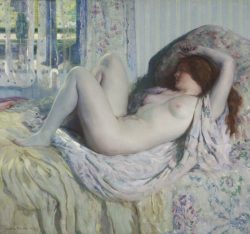
Lawton Parker, La Paresse [Idleness], dated 1913
Oil on canvas, 50 by 60 inches

Lawton Parker, La Paresse [Idleness], dated 1913

The lifesize nude woman in Lawton Parker’s La Paresse (idleness) reclines on a bed in full profile, one arm curved above her head in an attitude of indolence. Framed by her loose dark-red hair, the model’s face is shadowed and turned slightly away from the viewer, thereby highlighting by contrast the accessibility of her body. The cool pastels of the setting complement the pearly tones of her flesh, which are set off by the subtly vibrating surfaces of the variously patterned materials that surround her. The sunlit garden glimpsed through the casement window at the upper left is similarly muted by diaphanous curtains. In this striking life-size image, the sinuous curves of the woman’s body render her situation—disrobed and prone in daytime—all the more suggestively erotic.

Parker executed La Paresse in the French village of Giverny, where he first worked in 1903. In Giverny, Parker gradually abandoned the dark, tonal approach of his academic training and embraced the broken brushwork, bright color, and outdoor subjects of impressionism. He belonged to a group of American artists in Giverny—Karl Buehr and Pauline Palmer among them—who typically pictured pretty female models posed at leisure and out-of-doors. Along with his good friend Frederick Frieseke and his protégé Louis Ritman, Parker painted a number of nudes in the dappled sunshine of an enclosed garden or on riverbanks. He is said to have begun La Paresse when confined indoors by a rainstorm.

Parker synthesized disparate sources to create his modern interpretation of a classic subject. The academic training he received both in the United States and in Paris presumed the convincing portrayal of the human body, particularly the beautiful female form, as the ultimate artistic achievement. In La Paresse, the model’s languorous pose, with legs drawn up and one arm flung over her head, recalls the seductive nudes of old master painters, notably Titian’s Danaë (1553–54), which Parker knew firsthand from several visits to the Prado in Madrid. His use of decorative patterning throughout the image, on the other hand, reflects the influence of post-impressionism, particularly the paintings of the group of French artists known as the Nabis. The abundance of striped and floral designs surrounding the figure in La Paresse, as well as the harmonious palette of delicate blues, pinks, and lavender, characterize many of the interior compositions of Frieseke and Ritman, such as the latter’s Paris View.

La Paresse was one of Parker’s most widely exhibited and reviewed works. In the 1913 Paris Salon exhibition, it won the gold medal of the Société des Artistes Français, the highest award available to a foreigner. Even before the award was made, Sarah Hallowell, the Art Institute of Chicago’s agent in Paris, had selected the painting for that year’s American art annual, where it was exhibited under the English title Idleness. It arrived in Chicago too late for the awards competition, but in the exhibition, noted museum director William M. R. French, “it excites a good deal of admiration[,] especially among the artists.”[i] In the 1914 Carnegie International in Pittsburgh, Parker’s masterpiece was temporarily removed from display and omitted from the official catalogue because of concerns about viewers’ reactions to the nudity. Between 1914 and 1921, La Paresse was shown in at least ten other major exhibitions and won two more prizes. In 1915, it was reproduced as the frontispiece of a profile of the artist in the short-lived Chicago journal The Art Student in October 1915. Although Parker may well have had offers to purchase such a critically successful painting, La Paresse remained in his possession for the rest of his life.


[i]William M. R. French quoted in Richard Love, Louis Ritman: From Chicago to Giverny (Chicago: Haase-Mumm Publishing Company, Inc., 1989), 188.