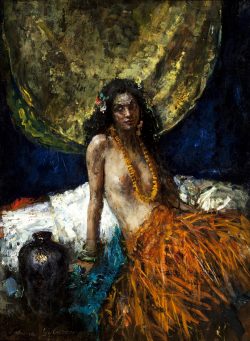
Indiana Gyberson 1875–1944
Although Indiana Gyberson received no shortage of critical attention in Chicago during the 1920s, few details of her life are known. Compounding the mystery surrounding her, the artist, born Anna Giberson, later adopted her mother’s first name of Indiana and changed the spelling of her surname to Gyberson; in recent auction records it has also been rendered as Gyborson. A native of Brooklyn, New York, Gyberson studied with William Merritt Chase in 1896. The following year, she traveled to Paris with her musically talented sister Mabel and their widowed mother, and in 1899 one of her figural paintings was shown in the Salon of the independent Société Nationale des Beaux-Arts at the Champ-de-Mars. Gyberson was living in the Sherwood Studios in New York in 1904, when she first showed her work in the annual American art exhibition at the Art Institute of Chicago. In 1912 she was again in Paris, where a severe eye injury forced her to adopt a new style of painting. By 1918, she had moved to Chicago, where she was a resident of the Tree Studios building and a participant in its lively social life. Gyberson’s debut in the Art Institute’s “Chicago and Vicinity” show in 1918 was favorably noticed in the Fine Arts Journal as “declar[ing] individuality in no uncertain language.”i
Gyberson specialized in paintings of seminude women posed in the studio with exotic oriental objects and costumes; she also exhibited a few portraits, still lifes, and landscapes. She was most active during the 1920s; in 1920 and 1924 her paintings were reproduced in the exhibition catalogues for the Art Institute’s “Chicago and Vicinity” exhibitions. In 1922, she completed a landscape mural for the Chicago home of retail executive and philanthropist Julius Rosenwald. The same year, she is said to have gone to New York with a contract from a gallery there, but she retained her Tree Studios address. Gyberson was an exhibiting member of the conservative Association of Chicago Painters and Sculptors and of the Chicago Galleries Association, where her paintings won prizes in 1926 and 1928. In 1925 and 1926, she also exhibited in the annual exhibitions of the Pennsylvania Academy of the Fine Arts in Philadelphia. Gyberson last exhibited in Chicago in 1928, when she was listed without an address in the catalogue for that year’s Art Institute “Chicago and Vicinity” show. By the time her death was reported by fellow Tree Studios artist Anna Lynch in 1944, Gyberson had been living in the eastern U.S. for several years, but no record remains of her later career.ii Chicago Tribune art critic Eleanor Jewett, who had often praised Gyberson’s paintings, remembered them as “among the most beautiful and original produced by the Tree Studio [sic] group.”iii
Wendy Greenhouse, PhD
i Evelyn Marie Stuart, “Chicago Artists’ Twenty-Second Annual Exhibition,” Fine Arts Journal 36 (March 1918): 7-8.
ii Eleanor Jewett, “Fort Sheridan Soldiers Form an Art Group,” Chicago Tribune, Sept. 24, 1944.
iii Jewett, “Fort Sheridan Soldiers.”