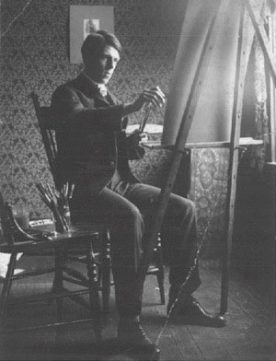
George Oscar Baker (1882–1948)
Born in Strother, Missouri, George Oscar Baker trained for a year at the Kansas City Art Institute and worked as a newspaper illustrator and comic artist in Missouri; Louisville, Kentucky; and Baltimore. By 1907 he was in Paris, where he enrolled at the Académie Julian; he also studied at the Académie Colarossi, under American expatriate painter Richard Emil Miller. While living and showing his work in Paris, Baker exhibited paintings in Milwaukee and in the Art Institute of Chicago’s annual exhibitions of American art in 1911 and 1912. He returned to the United States in 1912 and lived in New York City, showing his work in the 1913 National Academy of Design annual exhibition. The few extant examples of his painting demonstrate the strong influence of Miller as well as Baker’s gifts for fashionable portraiture and genre painting.
Baker soon abandoned fine art for a career as an illustrator. Moving to Chicago around 1918, he worked as a freelance commercial artist and then formed a partnership with a colleague in the field. Eventually he became an art director and executive in several Chicago advertising firms, notably Lord and Thomas. Perhaps to work in that company’s New York office, he relocated there in the 1920s. In the early 1930s, Baker may have fallen victim to the widespread unemployment of the Great Depression, for he was again working independently in 1933. He also founded and ran two clearing-houses for freelance advertising artists. In 1947, ill health forced Baker to retire to Florida, where he died at age sixty-six, leaving scant trace of his brief career as a fine artist.
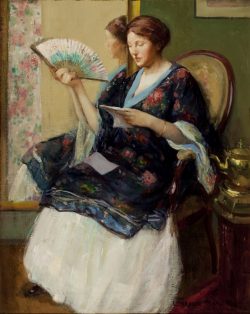
George Oscar Baker, The Chinese Coat, dated 1912
Oil on canvas, 32 by 26 inches
The young female model in George Oscar Baker’s The Chinese Coat is carefully posed, holding a letter in one hand and an oriental fan in the other. Close behind her upholstered chair, a tall gilt-edge mirror captures her gesture and reveals a swath of floral curtain. The reflective surface of the mirror is echoed at the lower right in the sheen of a polished teakettle set on a carved-wood stand. The corner of a framed picture at the upper right completes a setting that evokes both domesticity and refined aestheticism. It complements the woman’s luxurious dress: a black Chinese coat with a plunging neckline, embellished with pink flowers and a decorated hem, below which cascades a white gathered skirt. This elegant but informal ensemble belongs to the private space between sleeping and social presentation. Baker shows his model intently reading a letter, the stamped envelope of which lies in her lap. Her eyes downcast, she is oblivious of being observed, yet her posture seems deliberately designed to display her graceful form and striking costume.
Baker’s painting is an homage to the art of Richard Emil Miller, his most important teacher. Miller was a prominent member of the American expatriate artists’ community in Paris when Baker studied with him at the Académie Colarossi, between 1907 and 1912. As Miller transitioned during those years from the dark tones of academic practice to the brighter color and loose brushwork of impressionism, Baker followed his lead. In the composition and the pose and costume of his model in this painting, moreover, he closely followed the example of Miller’s recent painting, also called The Chinese Coat (location unknown), which was published in The Studio magazine in June 1911. Baker probably painted this interpretation of the theme around that time; it was one of his two paintings in the 1912 American artists’ annual exhibition at the Art Institute of Chicago. Notwithstanding the close similarities between their paintings, the two artists appear to have worked from different models, wearing similar but not identical garments.
By the time Baker painted The Chinese Coat, the image of an attractive woman wearing a distinctive article of clothing for which the work is titled had become something of a cliché among American figural painters. Articles of clothing and decorative objects with Far Eastern associations were particularly common in such works—for example, in the kimono and parasol featured in Pauline Palmer’s Woman in a Garden. As both painted details and actual garments, these objects lent a note of exoticism that flattered the increasingly cosmopolitanism tastes of well-to-do Americans.