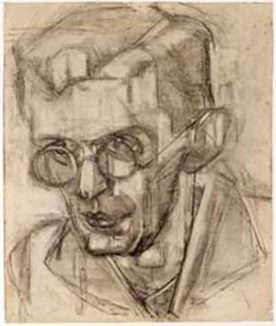
Isobel Steele MacKinnon, Edgar Rupprecht, circa 1927, charcoal on paper, 21¾ by 18½ inches. Courtesy Corbett vs Dempsey Gallery, Chicago.
Edgar Rupprecht 1889–1954
Edgar Arthur Rupprecht was born in Zanesville, Ohio, and raised in Chicago. He studied at the Art Institute of Chicago intermittently between 1906 and 1919. There and at the Summer School of Painting in Saugatuck (now known as Ox-Bow), in Michigan, he worked under Frederick Fursman, with whom he formed a close relationship. Rupprecht’s Saugatuck classmates included Arthur K. Houlberg and, in 1920, artist Isobel Steele MacKinnon, whom Rupprecht married in 1921. For the next four years, the couple lived in a studio-residence in the Tree Studios building on Chicago’s Near North Side and spent summers teaching at Saugatuck. Rupprecht painted commissioned portraits and did illustration and cartoon work, at one point assisting Richard Felton Outcault with his Buster Brown comic strip.
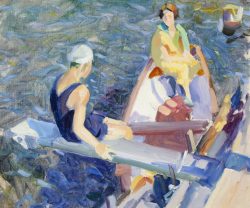
Rupprecht first exhibited in the Art Institute’s “Chicago and Vicinity” annual exhibition in 1916; seven years later, his painting The Diving Board was awarded a Marshall F. Holmes Prize. His best-known painting, The Summer Visitor (circa 1924; Union League Club of Chicago), earned a prestigious Municipal Art League Purchase Prize in 1925. Rupprecht’s reputation was at its height that year, when he and MacKinnon left Chicago for Munich. Supported by her family wealth, the two studied under modernist painter Hans Hofmann at his Schule für Bildenes Kunst (School for Modern Art). They traveled with Hofmann and assisted with instruction at his summer schools in Capri and Saint-Tropez. In 1929, the couple took up residence near Paris, where Rupprecht exhibited. They intended to stay in Paris indefinitely, but with the failure of MacKinnon’s fortune the couple returned to the United States in 1932 with their infant daughter.
The Rupprechts’ straitened circumstances forced them temporarily to take up residence in Fursman’s summer home in Saugatuck to save money, and Edgar joined the Federal Art Project, an artists relief program. In 1936 they joined many other artists living in the Old Town neighborhood on Chicago’s North Side. That same year Rupprecht resumed summer teaching at Saugatuck and he also lectured on Hofmann’s painting theory. Three years later the Art Institute appointed him an instructor of figure drawing, composition, and costume drawing. Teaching occupied Rupprecht until his death, and he exhibited his paintings until at least 1948.
Wendy Greenhouse, PhD