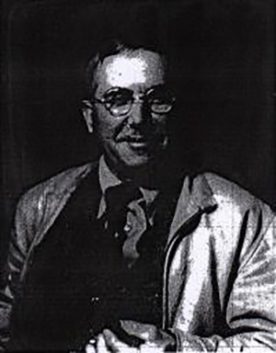
Charles W. Dahlgreen, from an undated photograph in Charles W. Dahlgreen papers, 1886–1957, reel 3954, frame 908, Archives of American Art, Smithsonian Institution.
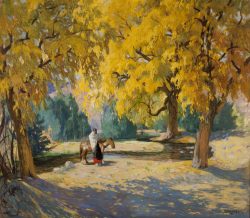
Charles Dahlgreen 1864–1955
Landscape painter Charles Dahlgreen was born in Chicago to a German immigrant textile dyer and worked as a youth painting signs and banners. In 1886, he traveled to Düsseldorf, Germany, for two years of academic art study. Returning to Chicago a newly married man, he set aside his artistic aspirations to launch a successful career as a manufacturer of painted and embroidered signs and flags, interrupted by a brief and fruitless search for gold in Alaska’s Klondike region. In 1904 Dahlgreen revived his artistic ambitions, studying first at the Chicago Academy of Fine Arts (founded in 1902) and then at the Art Institute of Chicago. His instructors included prominent figure and portrait painters, notably Frederick W. Freer. He also pursued landscape painting in summer classes conducted by John C. Johansen and Charles Francis Browne, and he studied the print technique of etching. Beginning in 1906, Dahlgreen’s landscape paintings and prints were included in the Art Institute’s annual exhibitions, which would regularly feature his work for almost four decades.
Following completion of his studies at the Art Institute, Dahlgreen returned to Europe to study and copy paintings of the old masters in museums in Belgium, England, France, Holland, and Italy, an experience he later cited as fundamental to his artistic development. He exhibited in the prestigious Paris Salons in 1910 and in 1912, the year he returned to Chicago. Dahlgreen’s career took a momentous turn in 1915 when, encouraged by Lucie Hartrath, he made his first visit to Brown County, Indiana, site of a burgeoning artists’ colony. Dahlgreen found a compelling subject in the region’s soft, hazy light and hilly topography and developed his distinctive artistic voice in paintings that won critical and popular favor. Dahlgreen also worked in Florida, the Ozark Mountains of Arkansas and Missouri, and Yosemite Valley in California, among other locales. In the 1930s, he stayed several times in Taos, New Mexico, joining a diverse community of artists. Dahlgreen exhibited widely, including in the Carnegie International and the Pennsylvania Academy of the Fine Arts annual exhibitions, but he remained closely affiliated with hometown institutions, including those in suburban Oak Park, where he settled in 1920.
Although identified with the conservative painters of Chicago, Dahlgreen was open-minded enough to consider other approaches to artmaking. He once copied an abstract work by pioneering Russian modernist Vassily Kandinsky, and he even painted his own modernist composition, a still life that won a prize at the Art Institute in 1934. Although he painted until nearly the end of his life, Dahlgreen was better known as a printmaker, creating popular, accessible images of subjects ranging from western mountains and midwestern farmlands to the contemporary cityscape and Chicago’s Century of Progress exposition of 1933–1934. A few years before his death at age ninety, Dahlgreen gave one hundred etched plates to the Smithsonian Institution; proceeds from the publication of a special edition of his prints supported significant acquisitions for the national print collection.
Wendy Greenhouse, PhD