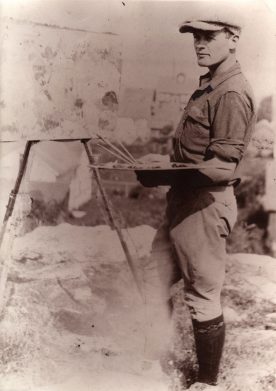
Arthur K. Houlberg painting at Saugatuck, circa 1919, from a photograph, courtesy Barbara Houlberg.
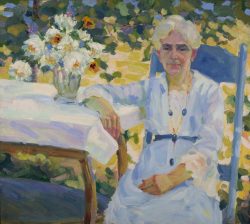
Arthur K. Houlberg 1895–1949
The eldest son of Danish immigrant parents, Arthur Klindt Houlberg was born in Chicago, where his father, a professionally trained decorative painter, owned a house paint store on the city’s Northwest Side. Houlberg studied at the Art Institute of Chicago beginning in his mid-teens, when he was already painting landscapes in oils; meanwhile, he worked as a newspaper artist. Following military service in France during World War I, he returned to the Art Institute and in 1919 he attended the Summer School of Painting at Saugatuck (now known as Ox-Bow) in Michigan, studying under his Art Institute teacher Frederick Fursman. In the spring of 1920, Houlberg was represented by two canvases in an Art Institute exhibition of student and faculty work from the previous summer’s program. The following year, he participated for the first and only time in one of the Art Institute’s regular annual exhibitions, showing Wash Day (circa 1920; Ox-Bow, Saugatuck, Michigan) in the “Chicago and Vicinity” exhibition. He earned an Arthur O. Goodman Prize for four of seven paintings he showed in the 1921 exhibition of the Art Students’ League of Chicago.
Most of Houlberg’s relatively few extant paintings are outdoor figural works and landscapes. They reveal his affinity for impressionism, with its broad handling of paint and preoccupation with bright light and color in images of the figure posed out-of-doors. Notwithstanding the promising beginning of his career as a painter, Houlberg abandoned the field for the commercial work he had pursued while an art student. Along with Edgar Rupprecht, a fellow student in the Saugatuck summer school, he worked on the syndicated Buster Brown cartoon strip, and he also taught art at Chicago’s R. T. Crane Manual High School. Houlberg eventually took a position in an advertising agency, moving from there to magazine publishing. He served as an editor, illustrator, cover artist, and photographer for Chicago Club Magazines, producing members’ publications for private clubs that included the Lakeshore Athletic Club, the South Shore Country Club, and the Medinah Athletic Club. Long an avid amateur photographer, he took up the medium seriously and belonged to the Fort Dearborn Camera Club. In 1936, Houlberg and his family moved to northwest-suburban Crystal Lake, where he spent the remainder of his life.
Wendy Greenhouse, PhD